
Start a Bellflower Residents Directory Search
Bellflower is an incorporated city in southeast Los Angeles County. It is not a separate county records jurisdiction. That split shapes every resident-record search. City Hall keeps the municipal side, holding minutes, permits, licenses, agreements, and code files. The county assessor holds parcel facts. RR/CC, the Registrar-Recorder/County Clerk, keeps deeds and vital records. Superior Court holds the cases, and libraries round things out with old city directories, phone books, census access, and local history.
Start from what you know. An address can yield an AIN before any name appears, while a known name can lead to a court party index, a business filing, or a directory entry. Pair an old city directory with census work. Census years narrow the hunt. No single Bellflower residents directory proves every occupant, since a deed shows legal interest rather than residency.
- Start with the Los Angeles County Assessor Portal when an address, parcel, or legal description is known. Save the AIN, situs address, and parcel-change details.
- Use the Los Angeles County voter-status lookup only when the last name, birthdate, house number, and ZIP are already known.
- For a deed or lien, take a likely party name and recording year to the RR/CC grantor-grantee index in Norwalk. The recorder cannot search its index by street address.
- For an older Bellflower household, compare the 1940, 1942, 1952, and 1955 Polk volumes with the 1947 telephone directory and the public 1940 or 1950 census.
- Use Bellflower's city archive or a California Public Records Act request for a municipal record that is not routinely posted, while sending specialized deed, court, vital, and voter requests to their own custodians.
Four Desks Behind Bellflower Resident Records
Match the custodian to the question and Bellflower records start making sense. The city clerk handles city business. The assessor identifies parcels and assessment facts. RR/CC covers recorded instruments, marriage and fictitious-business-name filings, and county vital records. Superior Court keeps case files and probate. Each desk reveals a different relationship to a Bellflower address, so treat none of them as a complete list of residents.
Los Angeles County RR/CC
12400 Imperial Highway
Norwalk, CA 90650
(800) 201-8999 option 3
Los Angeles County Assessor
500 W Temple Street, Room 225
Los Angeles, CA 90012
(888) 807-2111
Assessor Property Portal
LA County Election Information
12400 Imperial Highway, Room 2013
Norwalk, CA 90650
(800) 815-2666 option 4
Voter registration status
Bellflower City Hall sits at 16600 Civic Center Drive. The city clerk answers at (562) 804-1424, extension 2271. The Bellflower Courthouse, 10025 E Flower Street, is a Superior Court facility. It is not a city court. A court result, an assessor parcel, a deed party, and a voter status each count as separate evidence, so weigh them apart before combining them in a resident search.
Bellflower's Address-to-AIN Resident Trail
The Assessor Portal is the cleanest online first step from a Bellflower address to a parcel. Basic Search accepts an AIN or an address. Map Search places an address on the county map. Legal Search takes an assessment legal description instead. The AIN itself is a ten-digit key, arranged as map book, page, and parcel in a 4-3-3 pattern. Corner lots, multiunit buildings, and new construction can still need a map browse or a cross-street check.
| Search mode | Basic Search by AIN or address; Map Search; Legal Search |
|---|---|
| Parcel facts | Situs, ZIP, legal description, use code, tax-rate area, values, exemptions, building traits |
| History tabs | Ownership or parcel-change events, recording date, document number, and change reason |
| Not on the web | Owner name and owner mailing address; use an Assessor office or Property Data Sales |
The official Los Angeles County Assessor search shows how a parcel result supplies an AIN, situs, legal description, building details, and event clues. Those fields anchor a Bellflower records search. An owner is not automatically an occupant. A Home Owner Exemption is not conclusive proof of present residence either.
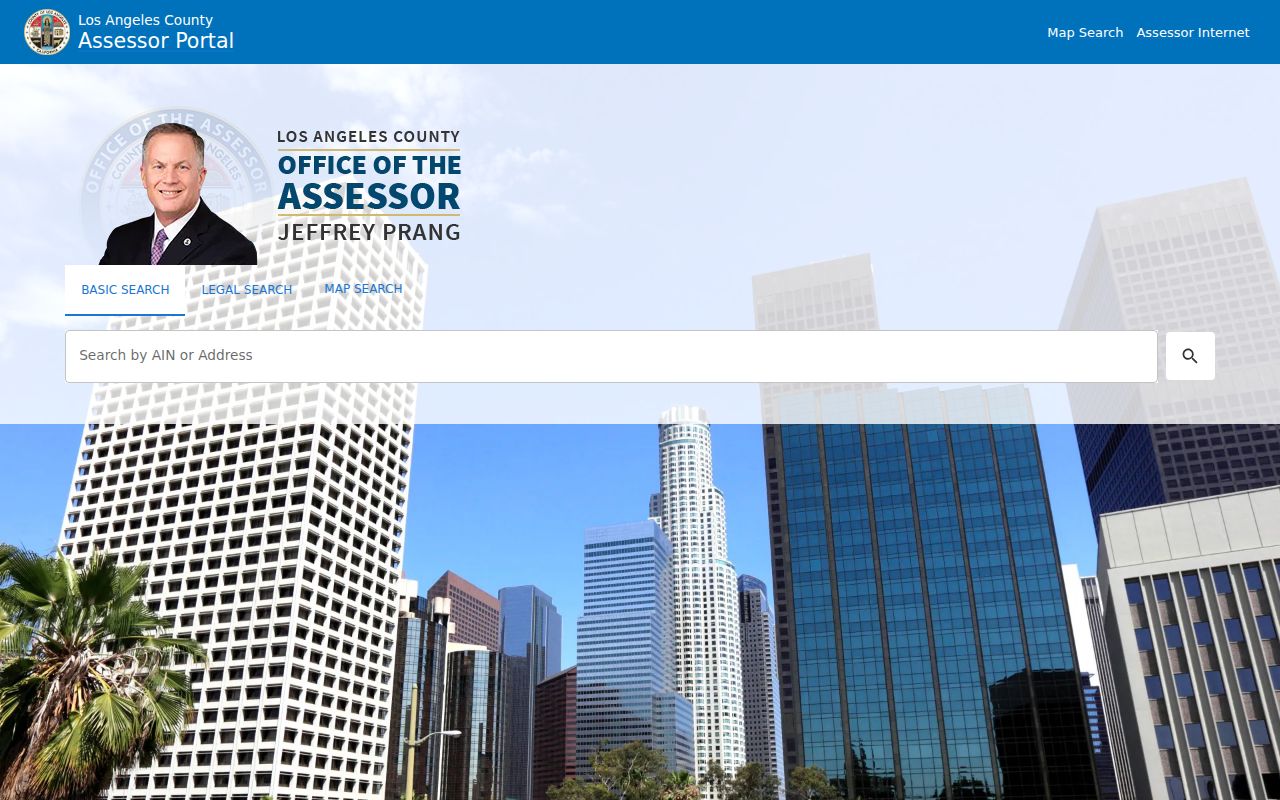
The Assessor's portal result covers only the parcel stage. Carry the AIN and legal description to the next custodian. A web result is not a list of people. Note: Situs names the taxable property's physical location, while a mailing address names where the county sends tax notices.
Bellflower Deeds Need an Offline Directory Search
Los Angeles County's real-estate index reaches back to 1850 or 1851. The grantor-grantee index is not online, though. It runs alphabetical by party name and recording year. The recorder refuses telephone index searches. An address or APN will not fit. The practical route runs address to AIN. Then it runs AIN to a current owner through an offline assessor channel. Owner name plus likely year goes to the recorder.
In Norwalk, records from 1851 to 1957 are reviewed downstairs. Records from 1958 onward sit in Real Estate Records Room 2207 on the second floor. Appointments open two weeks ahead. Book early. Bring the AIN. Search the index first. Note the document number, title, book, and page before deciding whether a complete copy is needed. Plain copies cost $5 for the first page and $3 for each additional page. Certified copies cost $6 for the first page and $3 for each additional page. Online, mail, and known-document orders follow different rules than a search.
The county's recorder access notice spells out the offline limit. It prevents a common wrong turn. An online request can order a known instrument. It cannot discover a Bellflower deed by street. Once a deed surfaces, its legal description and image can confirm the parcel relationship. The chain still names legal parties, not every past household.
Offline tip. Bring surname variants, the likely recording year, AIN, legal description, and any document number to reduce broad index work at Norwalk.
Current Sources for Bellflower Residents
Current records read as narrow rolls. The assessor supplies parcel and assessment facts. RR/CC adds recorded parties. Voter status can confirm a person's own registration details, but it cannot browse Bellflower streets. City files name applicants, contractors, speakers, and license holders in a municipal context, so a smart directory workflow keeps those scopes visible.
| Source | Who It Lists | Keeper | Access |
|---|---|---|---|
| Assessor parcel roll | Parcel facts and assessment data | LA County Assessor | Free web search; owner offline |
| Voter status tool | One voter's registration status | LA County Elections | Four-field self-check |
| Recorder index | Deed and lien parties | LA RR/CC | Free office review; copies cost |
| City archive and licenses | Applicants, speakers, businesses, agreements | Bellflower City Clerk | Laserfiche or CPRA request |
| Directories and census | Historical households and occupants | Libraries and NARA access | Coverage varies by year |
- Roll
- A custodian's organized list, such as an assessment or voter record, with a defined purpose and access rule.
- Index
- A finding aid that points to a fuller record. The RR/CC name-and-year index is not the deed image itself.
- Criss-cross directory
- A historical directory arranged by street and house number rather than only by surname.
- Parcel
- A mapped piece of land identified by an AIN and legal description; it is not a list of every occupant.
County rolls and commercial people-finders work differently. A county record sits with a named custodian. Its scope is defined. A commercial site may blend public data, licensed data, and guesses, then sell the mix as one profile. Check dates, names, and addresses before trusting either source. Trace each item back to its original custodian.
| Source type | Strength | Limit |
|---|---|---|
| Official Bellflower or county record | Known custodian, source fields, published access rules | May be offline, restricted, historical, or limited to one record purpose |
| Commercial people-finder category | May combine several data feeds into one paid report | Can be stale or conflated; does not amend the government source |
Pick the route that fits the job. The Bellflower resident lookup workflow suits a one-person search with an independent record trail. For a full street, parcel adjacency, and address-keyed files, the Bellflower street directory page follows the AIN-based sequence. It also covers lawful access. Neither route turns a specialized roll into a universal residents directory. Note: A city business license can reveal a local operation and contact path. But it creates no resident roster.
Bellflower Voter Status Is a Self-Check
The LA County Registration Status form asks for all four fields before it returns anything. That design matters. It is built to confirm your own record. It is not a public name-and-street browser for Bellflower.
Voter details are restricted under Elections Code section 2194 and Government Code section 7924.000. Anyone wanting full voter files or street-index products needs a contract, a permitted purpose, and the county's prescribed purchase process.
| Field | Type | Required | Format |
|---|---|---|---|
| Last Name | Text | Yes | Alphabetic only |
| Birthdate | Date or text | Yes | MM/DD/YYYY |
| House Number | Text | Yes | Numbers only |
| ZIP Code | Text | Yes | Numbers only |
The LA County voter-status form anchors the four-field flow. A returned record can show status, registration date, districts, and participation history. It withholds signatures, full birthdates, identification details, and protected-voter data. Safe at Home participants can use confidential registration.
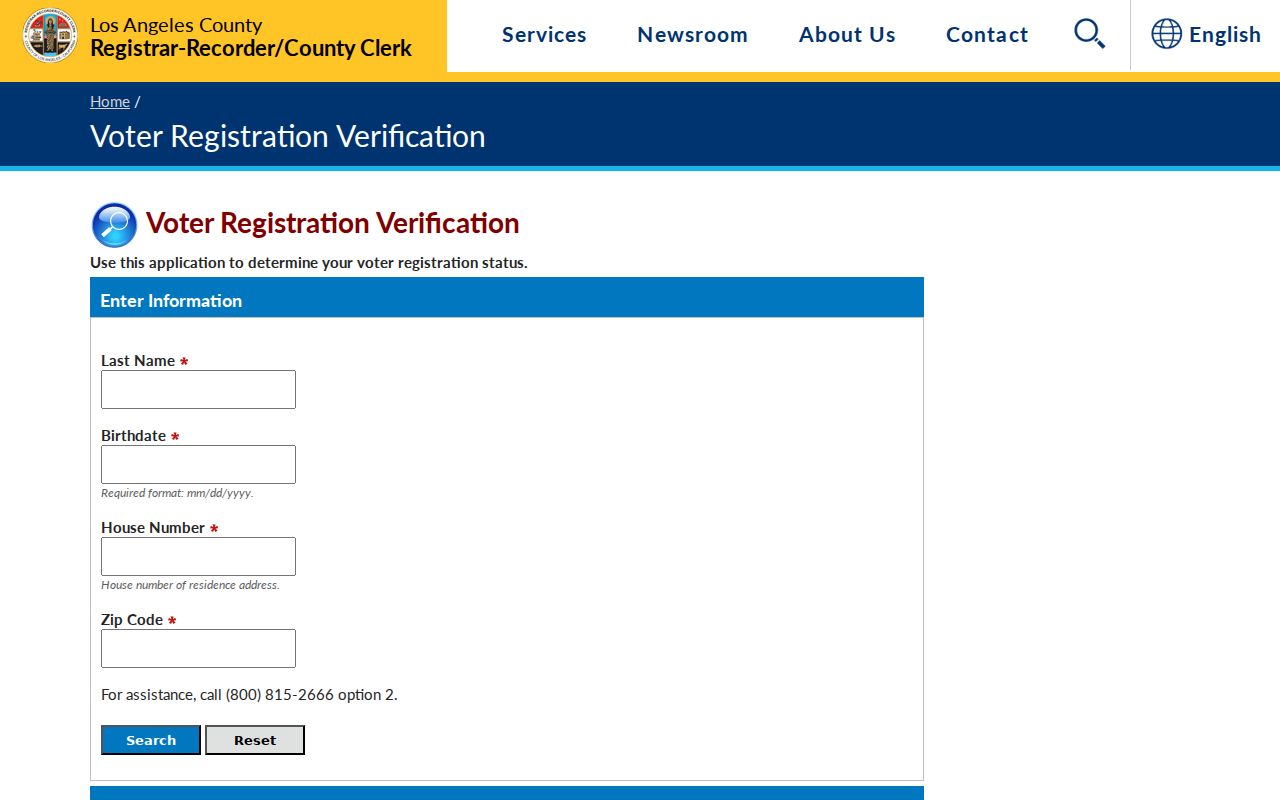
The form image explains why ZIP alone cannot build a Bellflower resident roll. ZIP is one credential among four, and a status is only a point-in-time confirmation.
Bellflower Court Records Are County Records
Bellflower Courthouse is a Los Angeles Superior Court facility at 10025 E Flower Street. Criminal and small-claims services run locally there. The Find a Case hub, meanwhile, splits these searches. Civil, small-claims, family-law, probate, and criminal defendant searches each get a separate tool. The court is not a Bellflower municipal court. A result may show a litigant name and case type. It may also list the filing date, location, case number, and the count of imaged documents. A missing result is not proof that no matter exists.
Fees apply to online name searches and images. Pages 1-5 cost $1 each, then $0.40 per page, capped at $40 per document. Courthouse copies run $0.50 per page plus the current certification charge. Courthouse terminals can supply a file path. The Archives & Records Center has public terminals too. The Archives center at 222 N Hill Street holds many 1910-2004 matters. These sit on paper, microfilm, or digital systems. Juvenile, sealed, adoption, and confidential records stay outside ordinary public results.
The LA Superior Court Find a Case hub displays the county's separate search divisions. A web result may lack the needed file. Then use the filing courthouse, the clerk, a mail request, or an archive terminal.
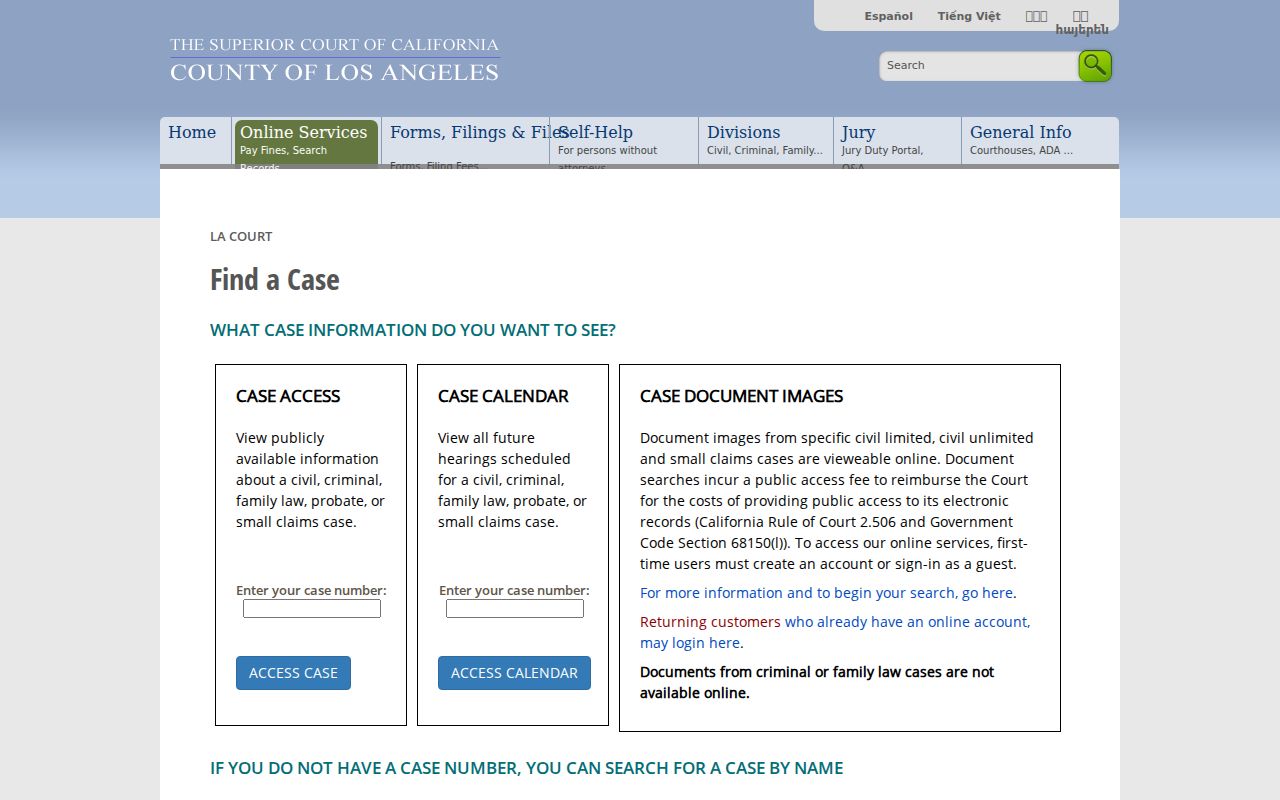
A court index is an identity clue and a filing path. It is not a full personal history, and a paid search is never a criminal-history certification.
Bellflower Vital Records and Copy Rules
LA RR/CC issues county birth, death, and public-marriage copies. The County Clerk handles confidential marriages. CDPH-VR provides statewide services, and a divorce decree belongs to Superior Court. California splits copies into authorized and informational versions. It does not open every birth record after one hundred years or every death record after fifty. A Bellflower record search should treat an index clue and an identity-valid certificate as different products. They are not the same product.
For 2026, LA County lists $34 for a birth copy. It lists $26 for a death copy and $19 for a marriage copy. State fees list $31, $26, and $19 in that order. CDPH says certified copies average 4-6 weeks. County online orders state up to 20 business days. Authorized mail requests need a notarized sworn statement. Informational copies can reach others, with redactions and an informational-only notice. Family Code section 511 limits confidential marriage records to the parties or a court route.
California's vital-record services explain the statewide route and the copy distinction. The form below is a concrete example of what a birth request needs. It is not an open name search.
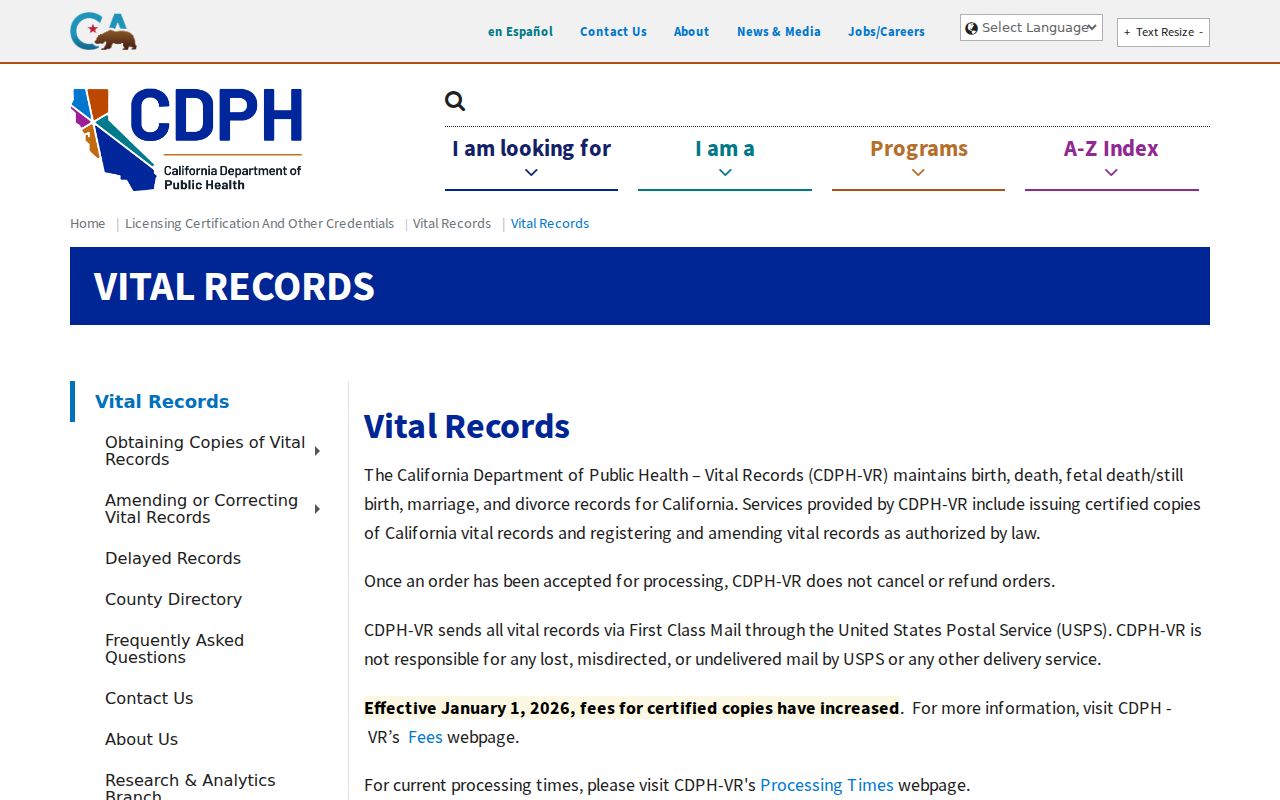
The vital-record image connects a directory clue to the right application path. Use the custodian's rules for identity proof, not a general search assumption. Note: The CDPH dissolution certificate covers 1962 through June 1984 and gives names, filing date, county, and case number, not decree terms.
Bellflower Heir, Classmate, and Business Trails
Each goal pulls on a different family of records. Heir work often starts with probate. There, a petition, notices, and a Superior Court or Archives file can follow. A classmate often hides in a yearbook, a school program, or a community archive. Business leads need comparing across records. Match the state entity filing against the county fictitious-business-name record and a Bellflower license. These sources complement rather than replace one another.
The state Business Search finds an entity by name or file number. It shows status, formation date, jurisdiction, addresses, agent, and filing people when the filing requires them. DCA's license search filters by board, license type, number, name, city, county, status, and discipline. The Controller's unclaimed-property search is free. It can yield an affiliation or address lead. Claim through official channels. Never pay a private fee to start a state claim.
For the state filing route, California's Business Search is the official source.
These entities answer separate questions. A state entity result names an affiliation. It does not prove an agent or officer lives at the listed address. Compare names, dates, and filing roles before drawing any household connection, and for the same reason the California DCA license search answers a licensing question rather than where someone lives.
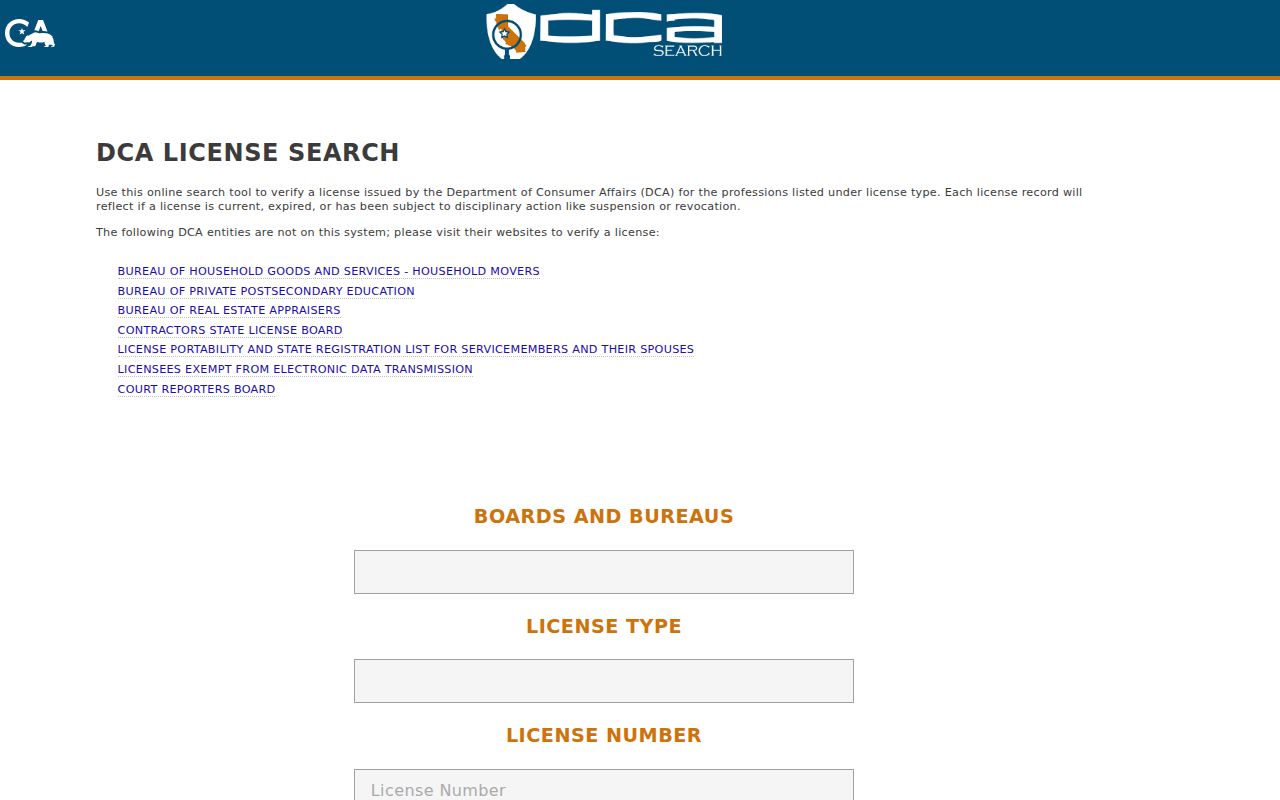
The professional search image sits beside the business trail here. A person can appear in several public capacities, and no single result proves a current Bellflower residence.
Bellflower Historical Directory Shelf
Four Bellflower-inclusive Polk volumes appear in the FamilySearch catalog. The years are 1940, 1942, 1952, and 1955. A Downey Historical Society finding aid adds a 1947 Downey-Bellflower telephone directory. LAPL's digitized regional material spans many city, business, phone, and reverse-street issues. Check it title by title for Bellflower coverage. The Bellflower city directory page follows the collection years. It also covers entry marks and the tracing method in full.
Copy the full entry for a past household. Include surname, given name, spouse, occupation, exact address, and any h/r notation. Then compare the matching census year. You can also use a reverse directory, a deed, a permit, or an obituary clue. Older research should also test Somerset, New River Colony, The Willows, and The Wilderness. Pre-incorporation labels do not always say Bellflower.
Note: A directory absence can mean no telephone, no response, a coverage gap, a move, or a different spelling rather than an empty address.
Bellflower Before Incorporation
Bellflower spent roughly forty-five years unincorporated. It incorporated on September 3, 1957. Before that date, people and places may be filed under Los Angeles County, a township or precinct, a school district, a post office, or an older community name. City Hall cannot supply a municipal minute book for years the city did not exist. For the earlier era, county deeds, school records, newspapers, directories, and community collections carry more weight.
Somerset School went up in 1910. It was enlarged in 1914. Later it became Bellflower School, then Washington School, before demolition in 1951. The school board was the area's only legally constituted elected body before incorporation. Its minutes and public programs are unusually useful civic traces. The Somerset Optimist began in 1912. Pacific Electric rights-of-way, subdivision records, flooding, and later levees can explain an early parcel description. It may differ from a modern street view.
Bellflower's Public-Records Request Route
Start with Bellflower's searchable Laserfiche archive when hunting agendas, packets, minutes, agreements, ordinances, or resolutions. Permits, licenses, and other municipal files belong in city channels, according to City Clerk guidance. A narrow question the archive cannot answer should go through the city's Public Records Act request. It should not go to RR/CC. Under Government Code section 7922.535, the CPRA determination rule allows roughly ten days. That window covers only the notice and determination, though, not the delivery of the record itself.
| Requester fields | Name, company or organization, phone, email, and signature/date |
|---|---|
| Request detail | Description, date range, property address or details, and optional file upload |
| Record choices | Building, Contract, Minutes, Ordinance, Resolution, or Other |
| Delivery | Preferred delivery or contact method |
Bellflower's public-records page shows the city archive and the route for a request.
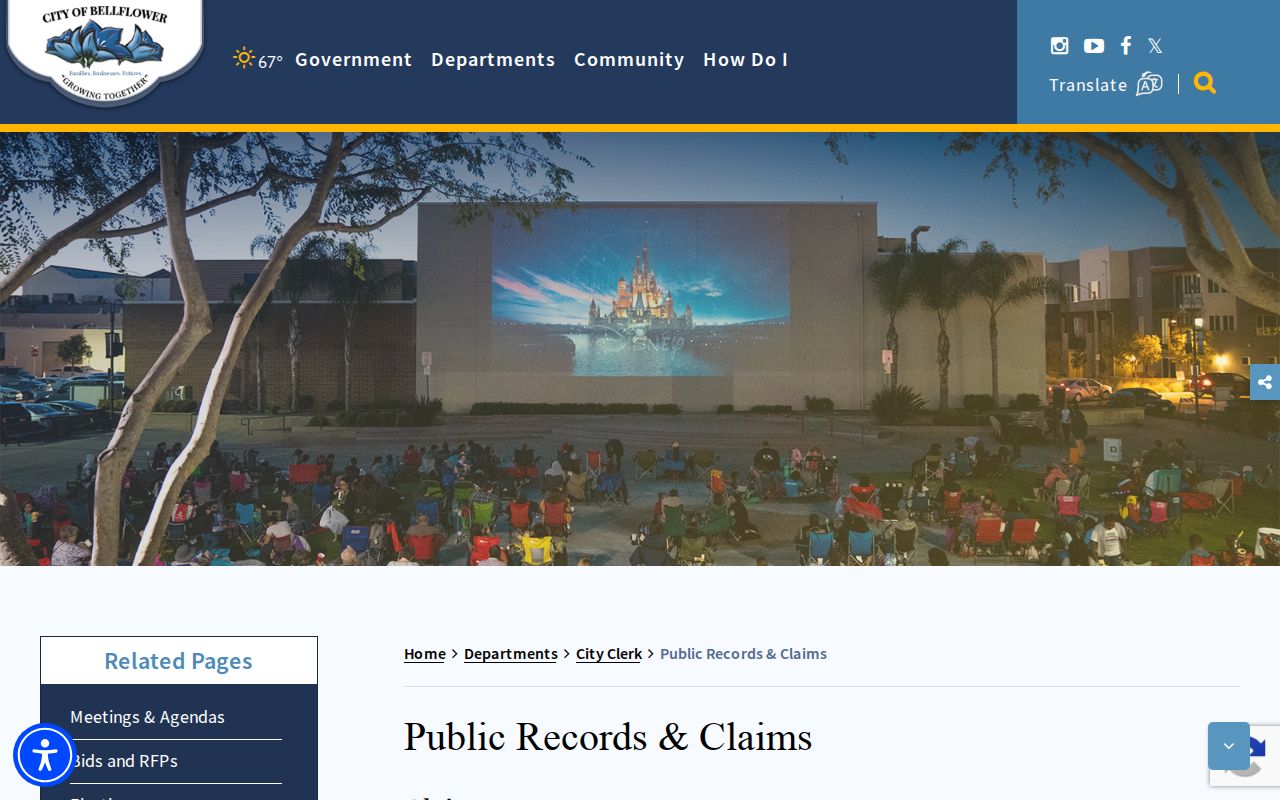
The city archive image belongs at the municipal branch of a directory search, so describe an address, AIN, record type, and bounded dates. Staff can then find a file without guessing.
Special records follow their own rules. Deeds use the RR/CC index and copy schedule, while vital records use authorized or informational categories. Court files follow Superior Court procedures. Voter files use Elections Code products and permitted purposes. The CPRA is a fallback for city records, not a replacement for those specialized systems.
Privacy Boundaries in Bellflower Records
Some people never appear in a public search. That absence is intentional. Safe at Home is one example. It gives eligible survivors and threatened people a substitute mailing address and confidential voter registration. Sealed court matters, juvenile files, confidential marriages, DMV personal information, utility accounts, and private household details stay outside ordinary public access. Voter rules also restrict street addresses, signatures, identification details, and other protected fields.
California privacy law grants rights against certain businesses, including access, correction, deletion, and opt-out. But deleting a data broker's copy does not rewrite a deed, court file, or government roll. The 2026 DROP program is scheduled to let one request reach hundreds of registered brokers. Processing begins August 1, 2026. Use the state's privacy channels for broker data. Go to the original custodian for a source-record correction.
Lawful personal use. Bellflower records are for lawful research, family history, civic understanding, and personal safety awareness. Do not use a records search to stalk, harass, threaten, or harm anyone.
Bellflower Record-Use and Scam Checks
Records carry practical dangers of their own. A deed-copy letter may tack on a steep markup. Skip the link in the letter and reach the RR/CC page on your own, then weigh the price against the county's published copy schedule. Owners can register for the property e-Notification service, which sends word whenever a document records against the parcel, yet it stops no filing and never substitutes for title review. Scammers mine obituaries for family details. Jury and warrant scams press for gift cards, cryptocurrency, or a kiosk payment.
Verify every contact through a known government domain and a number you found yourself. Call 911 for immediate danger. Bellflower relies on the LASD Lakewood Station for law-enforcement service. Complaint routes differ by type: the California Attorney General takes consumer issues, IdentityTheft.gov handles identity theft, the FTC covers general fraud, the Postal Inspection Service pursues mail fraud, and IC3 fields internet fraud. Unclaimed-property claims start free at the Controller's site. No paid intermediary is required.
| Concern | Independent route | Bellflower-specific check |
|---|---|---|
| Deed-copy solicitation | LA RR/CC recorder page | Compare the published copy price |
| Property filing alert | RR/CC e-Notification | Alert warns; it does not stop recording |
| Immediate danger | 911 | Do not wait for a record search |
| Local non-emergency | LASD Lakewood Station | (562) 623-3500 |
Note: A `.gov` link and a familiar office name prove nothing on their own; check the URL and reach the office independently.