
Trace a Bellflower Street Directory
A Bellflower street search works best when you begin with the place itself. Do not guess about who lives there. Record the house number and the exact street spelling. Add any unit, the ZIP, and nearby cross streets. One parcel in Bellflower can carry more than a single service address. A mailing address may sit somewhere else entirely. Keep property records, title evidence, permitted voter confirmation, and historical household records in separate piles as you work.
- Start with the address. Normalize the wording and keep the unit. Retain the postal city until parcel boundaries are checked.
- Find the AIN. Run the address through the Los Angeles County Assessor, then save the AIN, situs, legal description, status, and map. If it fails, try the map, cross streets, or a nearby parcel.
- Build the deed chain. Owner information is absent from the public web result. Use the Assessor counter or data service, search that name as a Recorder grantee in the likely year, match the legal description, and follow the prior grantor.
- Use voter records only for a permitted purpose. The county status form confirms a person’s own registration with last name, birthdate, house number, and ZIP. A full Street Index is restricted.
- Add reverse-directory evidence. Search a Bellflower-inclusive city, telephone, or criss-cross volume for past occupants, compare the alphabetical entry and census, and treat an old listing as a dated clue.
The chain runs in steps. Address leads to AIN, AIN leads to parcel, owner leads to deed parties, and a historical address leads to a household. No single source answers everything.
Bellflower Records by Address
Bellflower address records live with city, county, library, and election custodians. Assessor and GIS tools locate land. The Recorder establishes when a transfer happened. City files show work done on a property, and old directories supply earlier clues. The voter Street Index serves its own permitted purpose.
| Address record | Keeper | What it can establish | Access route |
|---|---|---|---|
| Assessor parcel roll | LA County Assessor | AIN, situs, legal, tax, value, building facts | Free address/AIN/legal/map search; owner and mailing offline |
| Parcel GIS | LA County GIS | Shape, AIN, situs fields, adjacency | Free viewer or REST service; no owner field |
| Deeds and liens | LA RR/CC | Parties, dates, document type, legal description | Norwalk name-and-year index; paid copies |
| Permit and code files | City of Bellflower | Work, applicant, agent, contractor, valuation, inspections | Address or AIN request; no verified public database |
| Voter Street Index | LA County Elections | Registered-voter information under a permitted product | Contract and purpose rules |
| Reverse directories | Libraries and historical collections | Past occupants, subscribers, businesses, street order | Digitized collections, catalogs, reading rooms |
The AIN links the modern parcel to a city request, yet it cannot make the Recorder searchable by street. Carry the AIN and legal description into permit work. Check neighboring parcels one at a time, and cite every old directory by year and geographic scope.
Search Bellflower Assessor Fields
The LA County Assessor gives you a basic address or AIN search, a map search, and a legal-description search. There is no online owner-name mode and no ZIP-wide people search. A failed match often hides a unit, directional, abbreviation, corner, multiunit, or parcel-change problem. Try the map. Try the legal description too. Only then decide an address is missing. Assessor help answers at (888) 807-2111 or (213) 974-3211.
| Mode or field | Input | What to check |
|---|---|---|
| Basic Search | AIN or street address | AIN, situs city and ZIP, legal description, type, status |
| AIN | Ten digits: map book 4, page 3, parcel 3 | Keep predecessor or successor AINs after a split or merger |
| Map Search | Map, place, or address locator | Parcel polygons, cross streets, corner or multiunit geometry |
| Legal Search | Assessment legal description | Lot, tract, and legal wording when an address changed |
| Owner or ZIP search | Not an online public mode | Assessor office, data service, phone, or AIN-specific inquiry |
A result can show situs, tax-rate area, use code, land and improvement values, base years, exemptions, and building traits like year built, effective year, units, beds, baths, and square feet. Zoning references, parcel maps, and change-event tabs round it out. None of that describes a household. The GIS layer adds AIN or APN and segmented situs fields, supports spatial queries, and caps results at 1,000 records.
- AIN
- The Assessor Identification Number, a ten-digit map-book, page, and parcel key.
- Situs
- The parcel’s physical taxable location, which may differ from its postal city.
- Mailing address
- Where tax notices go, possibly to a trust, manager, or owner elsewhere.
- Parcel
- A mapped land unit with an assessment identity; one address can span more than one.
- Plat
- A recorded map of lots, streets, easements, and parcel relationships.
- Criss-cross directory
- A reverse directory arranged by street and house number for historical occupant research.
Ownership history gets murky fast. Trusts, LLCs, spouses, inheritance transfers, and tax quirks all bend the chain. A Home Owner Exemption proves nothing about who actually lives there. Note: The public parcel portal identifies a taxable place. Its missing owner field reflects policy rather than missing data.
Walk Bellflower Parcels in GIS
The Los Angeles County Parcel MapServer lets you walk a Bellflower block without mistaking polygons for people. Find or pan to the address and zoom until the parcels draw. Click the target and save its AIN and situs. Then click each side-adjacent and rear parcel one by one.
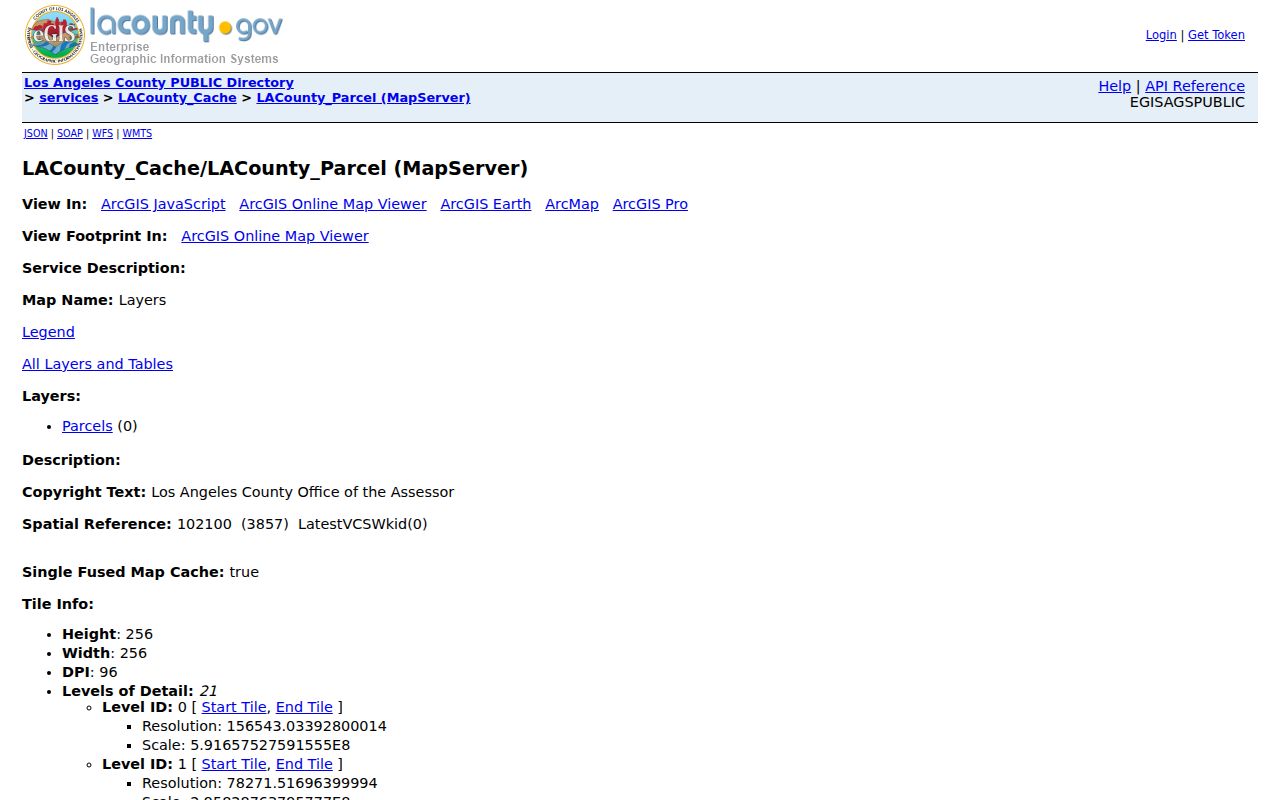
The service handles spatial and distance queries, pagination, ordering, distinct values, and statistics. Still, it caps at 1,000 records and shows no owner field. Parcels only draw at close zoom. Multiunit geometry cannot list units or household members. Today's adjacency may also differ from the historic pattern after a split, widening, or right-of-way change.
Take Bellflower Deeds to Norwalk
Los Angeles County real-estate records reach back to 1850 or 1851. But the deed index is not online and cannot be searched by street address or APN. It runs alphabetically by grantor, grantee, and recording year. An online request only orders a document you already know about. It will not discover deeds along a street. The Recorder's official access notice spells out the limit.
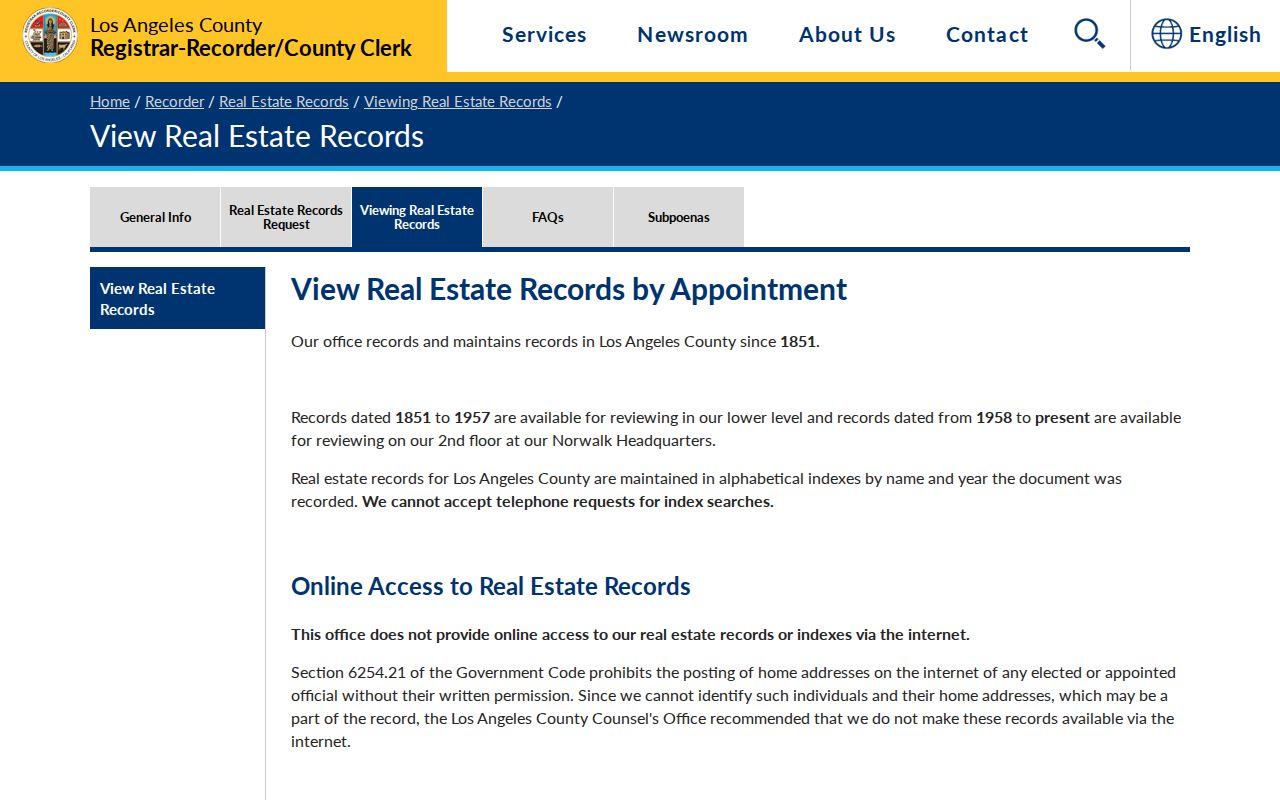
That notice points back to the counter. Get an owner name from the Assessor counter or Property Data Sales first. Then carry the name and a likely year to Norwalk. Staff at (800) 201-8999, option 3, or recorder@rrcc.lacounty.gov explain service. They will not search the index by phone. Records from 1851 through 1957 sit downstairs. Everything from 1958 onward is on the second floor, Room 2207. Weekday desk hours run 8:00 a.m. to 5:00 p.m. Appointments can be made two weeks ahead. For known documents, use the county's recorded-document request route, mail or fax to P.O. Box 1130, Norwalk, CA 90651-1130, or the online copy channel. Plain copies cost $5 for page one plus $3 each extra. Certified copies run $6 plus $3 each extra. You buy the whole document. Online processing is stated within 20 working days. Cards or contactless add $1.75, and checks or money orders follow the rules.
- Anchor the parcel. Save AIN, situs, legal description, change tabs, and any known document number.
- Search the grantee. Try name order, initials, hyphen or space variants, trust terms, and entities.
- Read the filing. Grant, quitclaim, correction, trust transfer, and inheritance filings are not all ordinary sales.
- Match the legal identity. Reject same-name results whose parcel description does not fit.
- Walk backward. Take the grantor as an earlier grantee and cross the 1958 floor boundary when needed.
Splits, mergers, trusts, and multiunit addresses all break simple chains. A deed names recorded interests, not every occupant. Note: A Recorder name-and-year result cannot prove who occupied a Bellflower address.
Bellflower Permits and Business Licenses
City Hall keeps the municipal files, while the county holds the deeds. The City Clerk’s Bellflower public-records route opens the archive and the CPRA request process. City Hall sits at 16600 Civic Center Drive, Bellflower 90706, open Monday through Thursday from 8:00 to 5:30 and Friday from 8:00 to 4:30, with alternating Friday and holiday closures. For records help, call (562) 804-1424, extension 2271, or write to cclerk@bellflower.ca.gov.
The Bellflower Laserfiche archive should be the first stop for city searches covering minutes, packets, agreements, ordinances, and resolutions. The CPRA form gathers requester and organization details, contact information, a description, a date range, and a property address or other details, plus a delivery choice, signature, and date. Checkboxes cover Building, Contract, Minutes, Ordinance, Resolution, and Other.
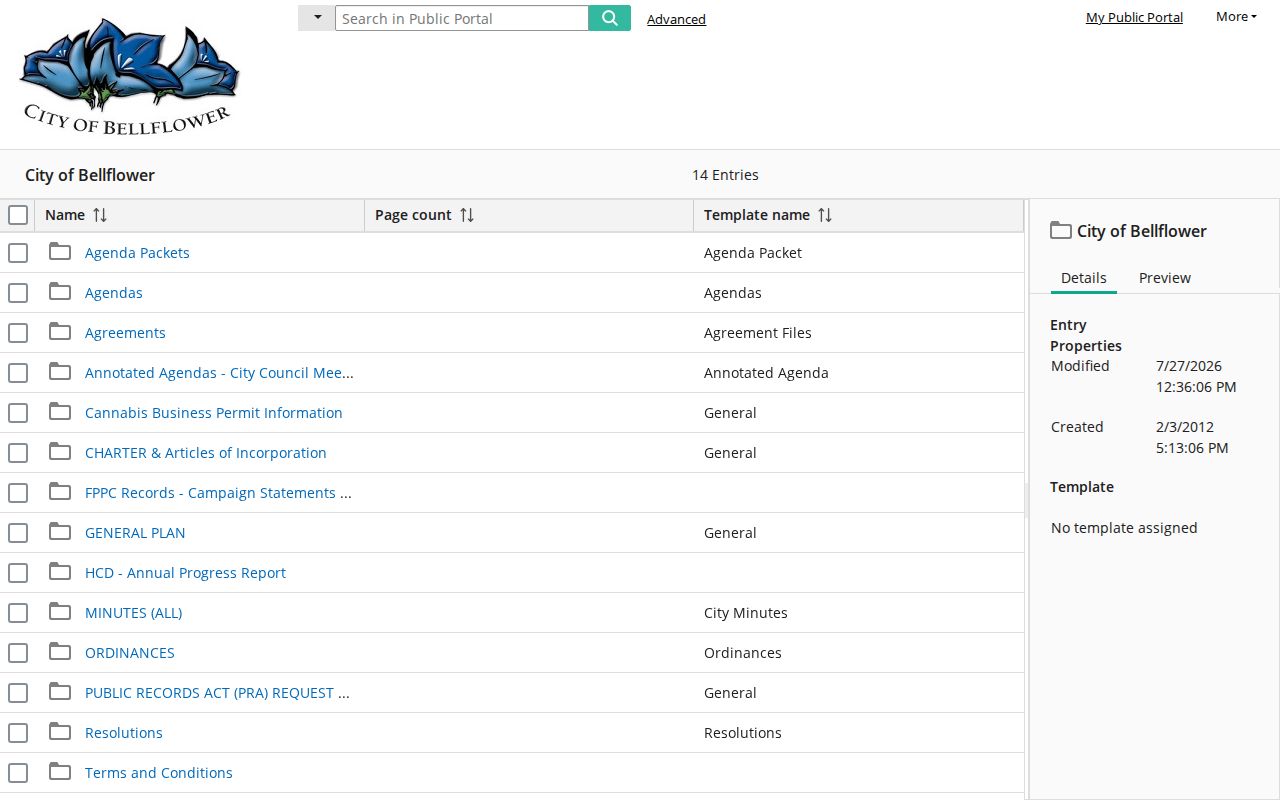
Start with that archive, but keep expectations in check. California's CPRA rule gives an agency ten days to decide on availability and timing. It does not force production. Bellflower publishes no online permit database. Request permit, inspection, or code files by address, AIN, and bounded dates.
Building and Safety handles permits for patio covers, HVAC, plumbing, electrical work, walls, pools, and spas. An address file may list the applicant, owner or agent, contractor, scope, valuation, and inspections. Exemptions and redactions apply. For routing, the city's Bellflower permit information page is the practical starting point.
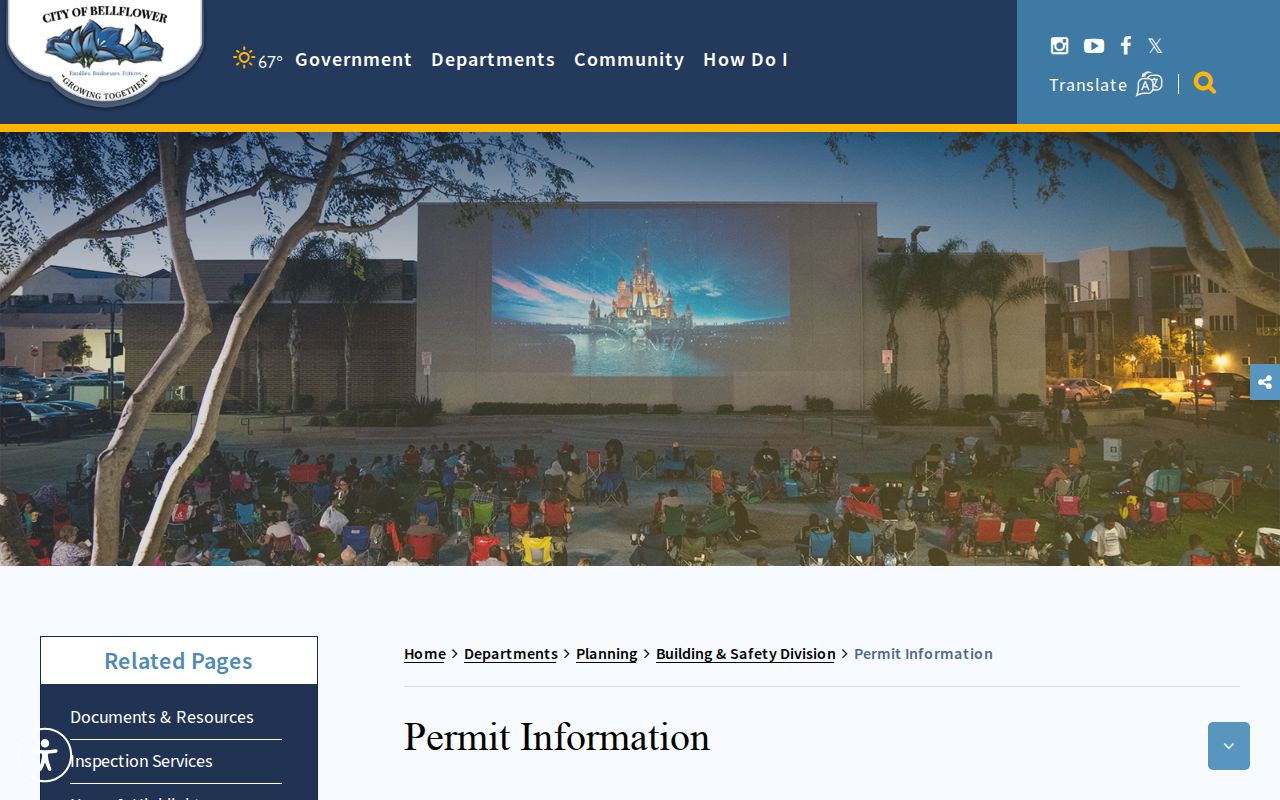
The image signals the Building & Safety route. A local license adds a separate clue. Bellflower connects searchers to a Business License Search. The Business License Division answers at (562) 804-1424, extension 2008. Its live fields and coverage are not fully verifiable from outside. Remember that city licensing sits with one custodian. A county fictitious-business-name filing sits with another, and a state entity filing with a third. Each may show a different name for the same venture.
Bellflower Street Names and Reverse Directories
Bellflower did not incorporate until September 3, 1957. Earlier records may carry county, township, precinct, school, or post-office labels instead. Search under New River Colony, Somerset, The Willows, The Wilderness, and Bellflower. Then compare the legal description. Pacific Electric rights-of-way, subdivision work, flooding, and levees can all explain irregular blocks. No mass Bellflower street-renumbering chronology exists in published form. So test spelling, abbreviation, parcel change, and coverage before assuming a number changed.
Two regional collections carry the old street directories. The Los Angeles Public Library's collection spans 1873 to 1970. Street-reverse issues are listed for 1906, 1927, and 1956 to 1987. Search the LAPL directory collection by person, business, or street. Then confirm Bellflower in the title. FamilySearch catalogs Polk volumes for 1940, 1942, 1952, and 1955. The Downey Historical Society Reading Room lists a 1947 Downey, Bellflower telephone directory. The Polk catalog may require login or affiliate access.
Entries can show a spouse, occupation, address, and an h or r marker. OCR may render that marker as noise, or reduce a street to a bare name. Compare the alphabetical entry, the reverse street entry, and the census year. Do this before trusting any single line. Brakensiek Library, 9945 Flower Street, (562) 925-5543, offers reference help. Norwalk's Californiana Collection can check closed stacks. The fuller historical shelf belongs with the Bellflower city directory collections. Note: A missing listing may mean no telephone, no response, a coverage gap, or an unindexed household.
Bellflower’s Restricted Voter Street Index
The county's voter-status form exists for self-confirmation. It asks for Last Name, Birthdate, House Number, and ZIP Code. The formats are alphabetic text, mm/dd/yyyy, and numeric. It will not browse a Bellflower street. It will not accept a name alone either. For help, call (800) 815-2666, option 2.
A voter file can hold name, residence or mailing address, status, party, registration date, precinct, districts, and participation history. It never includes ballot choices. ID data, Social Security information, full birthdate, signature, and protected-voter data stay restricted. Elections Code sections 2167, 2188, and 2194 plus Government Code section 7924.000 limit use.
Prescribed files require a contract and an allowed election, scholarly, journalistic, political, or governmental purpose. The county's voter data and fee information lists countywide files at $146. Precinct, district, or city files run $54. Additional files cost $39. Street Index pricing for candidates or committees also appears there. Requests go to Election Information, Room 2013, 12400 Imperial Highway, Norwalk. Ordering happens by appointment, mail, or phone at (800) 815-2666, option 4. You can also write voterinfo@rrcc.lacounty.gov. Safe at Home voters may be confidential. Treat any status as time-specific. It is never permanent proof of residence, ownership, or every person at an address.
90706, 90707, and Bellflower Limits
USPS places the Bellflower Post Office at 9835 Flower Street, with 90706-9998 service. Weekday retail runs 9:00 to 5:00. Saturday hours are 9:00 to 2:00. The PO Box lobby is open 7:00 to 7:00, with General Delivery and PO Box Online. For delivery details, use the official USPS address lookup.
ZIP 90706 is Bellflower's geographic street-delivery ZIP. Its 2020 ZCTA reports 79,179 people and 24,683 residential units. ZIP 90707 is different. It is a non-geographic Bellflower PO-box companion, not a second residential district or residential ZCTA. The nearby 2020 city figure of 79,190 does not make ZCTA and city boundaries equal.
None of the county systems browse by ZIP alone. The Assessor offers no ZIP-only search. The voter form uses ZIP as one of four credentials. The Recorder has no ZIP or address mode at all. A 90706 mailing address may sit outside incorporated Bellflower. An owner's mailing address may be somewhere else entirely. Confirm postal delivery with USPS. Confirm parcel location with Assessor and GIS. Confirm city jurisdiction with parcel or city evidence.
What a Bellflower Street Directory Leaves Out
No address record supplies a complete household list. Utility, DMV, private, court-sealed, and confidential records never become open street indexes. Safe at Home may substitute or suppress a protected address altogether.
Bellflower's community layer works as a contact route, not a resident roster. Neighborhood Watch has six districts and captains. The captains coordinate block communications and meetings. No public member list exists. Clubs, the Chamber, Friends of Brakensiek Library, and other civic groups may publish organization contacts. They keep home details private. When the question narrows to one named person, turn to the Bellflower resident lookup workflow instead of stretching a street record.
Lawful use. Bellflower address records support personal research, family history, property curiosity, and civic review. Do not use a record to stalk, harass, intimidate, publish a protected address, or pressure anyone; public availability does not remove those limits.
A careful street directory result stays modest. A parcel lead is not a household. A deed names a recorded interest, a permitted voter product has a purpose, and a reverse entry belongs to its own year.