
Bellflower City Directory Collection Map
Bellflower's historical directory trail is regional, not a single city shelf. The verified core is R. L. Polk & Co.'s Polk's Lakewood (Los Angeles County, Calif.) city directory, including Bellflower, Lakewood Plaza and Paramount. Four volumes are cataloged: 1940, 1942, 1952, and 1955. A separate 1947 Downey-Bellflower telephone directory is in the Downey Historical Society Reading Room. LAPL adds regional city, business, phone, and reverse issues, while Norwalk's Californiana Collection supplies a staff-assisted fallback. A title must name Bellflower or the relevant community before a result is treated as local.
| Collection | Years | Where Held | Access |
|---|---|---|---|
| Polk Lakewood, including Bellflower | 1940, 1942, 1952, 1955 | FamilySearch catalog 23218 | Images may require login or affiliate access |
| Downey-Bellflower telephone directory | 1947 | Downey Historical Society Reading Room | In person |
| LAPL city, business, and phone collection | 1873-1970 | LAPL digital collection | Free online; verify title scope |
| LAPL street-reverse issues | 1906, 1927, 1956-1987 | LAPL digital collection | Free online; issue scope varies |
| Norwalk Californiana directories | Nineteenth century and later | LA County Library closed stacks | Staff title check required |
These are verified routes, not a complete annual shelf run. FamilySearch may limit images, LAPL coverage varies by issue, Norwalk uses closed stacks, and Brakensiek's exact Bellflower run is unverified. Preserve the title, named community, year, and access point with each citation.
Use each route for its strength: FamilySearch establishes the Polk catalog, Downey gives the 1947 subscriber layer, LAPL supports OCR and street-reverse search, Norwalk offers staff-held material, and Brakensiek can test local-history leads. A library card, affiliate login, or in-person request may be required, but none of those limits turns an unverified title into a missing record.
Bellflower City Directory Polk Volumes
The four Polk years give Bellflower a mid-century spine. Pair 1940 with the public 1940 census, use 1942 to test continuity, and compare 1952 with 1955 for later address, spouse, occupation, and spelling changes. The 1947 telephone volume is a narrower subscriber source, so a missing name may reflect listing choice or lack of telephone service rather than a move.
The FamilySearch catalog record for the Bellflower-inclusive Polk volumes identifies the publisher, title, edition years, and named communities.
Open the front matter before reading entries. Record the volume title, publisher, year, communities, canvass date if given, and abbreviation key. Login or affiliate-site rules may block a scan, so use the catalog and another documented access channel rather than guessing.
Note: A printed volume date can reflect an earlier canvass, not a precise move-in day.
Searching Bellflower City Directories Online
LAPL's digitized regional city, business, and phone collection covers 1873-1970 at collection level. Its street-reverse years include 1906, 1927, and 1956-1987. Search by person, business, or street, then inspect the issue title and community line because only some regional volumes include Bellflower.
The LAPL digitized city and street directory collection is the online route for those regional issues.
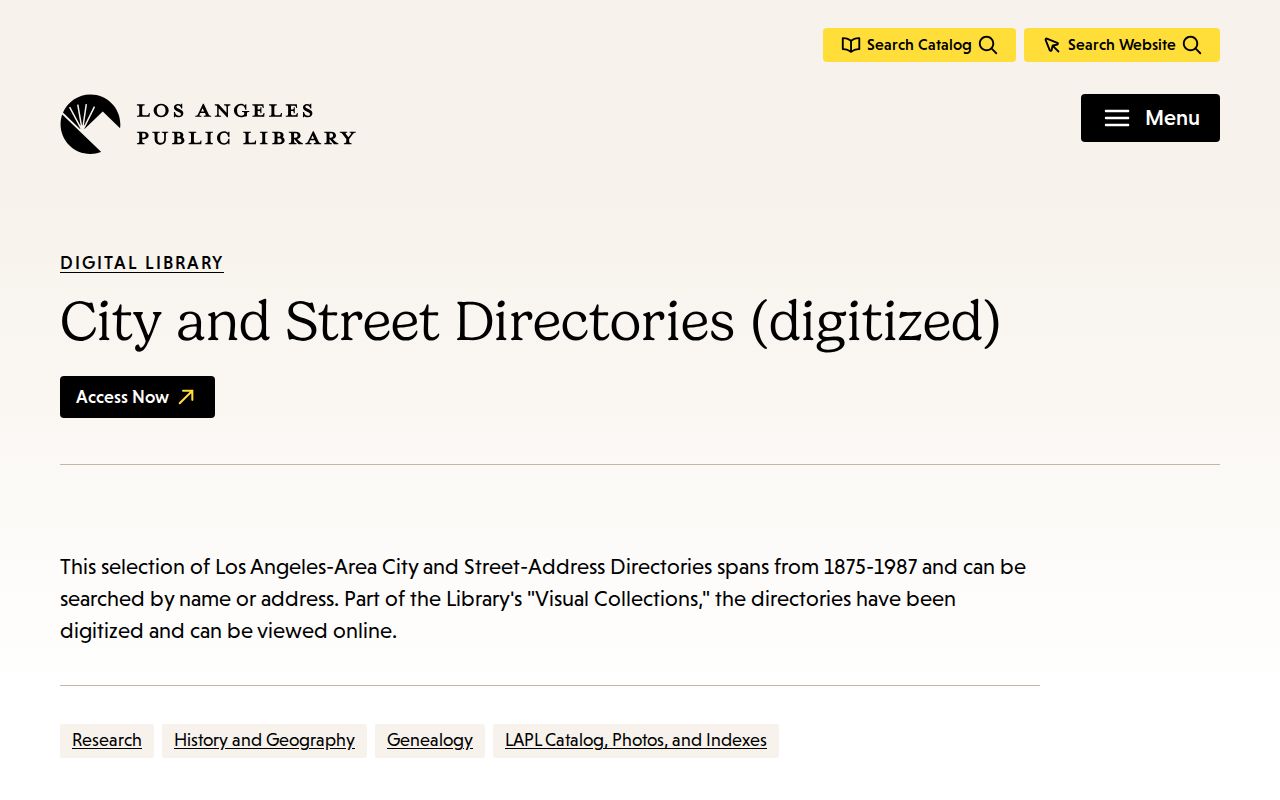
LAPL OCR often puts h before a householder address and r before a resides entry. Try both prefixes, then a bare or abbreviated street. The directory index fields are Keyword, City or Community, County, and State/Province; & joins terms, / offers alternatives, and * truncates. Save the scan citation when OCR and image text differ.
Note: A failed exact search is a reason to shorten the street stem and test both h/r prefixes.
Reading Bellflower City Directory Entries
A Bellflower directory entry is a dated clue set, not a full household census. Regional conventions include name, spouse in parentheses, occupation or work address, residence, widow notation, and h or r. The exact Bellflower page and symbol key were not available for inspection, so the volume's own front matter controls.
| Name | Copy surname, given name, initials, spelling variants, and any “see” reference. |
|---|---|
| Spouse | Record a parenthetical spouse as a relationship clue. |
| Occupation or work address | Use the printed occupation, employer, or work place to separate same-name entries. |
| Residence | Copy house number, street, city wording, and address abbreviations. |
h and r | Regional usage means householder and resides; confirm the volume key. |
| Ownership or widow mark | Use only symbols defined in that issue; no Bellflower-specific key was inspected. |
Copy the whole entry before interpreting it. A spouse, exact street, and occupation can separate people with the same surname and initial. A changed given name may signal a new household, while a changed address needs a second source.
- Criss-cross directory
- A street-order section that reverses the name index to list occupants or businesses by street and number.
- Householder index
- An index organized around the person or address anchor used to identify a household, not every resident.
- Abbreviation key
- The front-matter legend for short forms and symbols. Read it before translating address or household marks.
Bellflower City Directory Reverse Clues
Reverse or criss-cross pages help when a family story starts with an address. The street section usually runs by street name and house number, with an occupant or business beside the location. LAPL's reverse years are collection-level dates, so each issue still needs a Bellflower coverage check.
Walk house numbers when the volume allows it. A missing number may mean vacancy, nonresponse, construction, a boundary omission, or a numbering difference. Preserve the historic spelling and modern form because OCR can split one street into several searches.
For modern parcel facts, use the separate Bellflower Street Directory address workflow. A historical reverse hit adds an occupant layer, but it does not turn an owner, subscriber, or listed person into the current resident by assumption.
Note: A street-order hit identifies what one volume recorded, not every person at the address for the whole year.
Bellflower Directory Reference Desks
Clifton M. Brakensiek Library is at 9945 Flower Street, (562) 925-5543. The first Bellflower branch opened March 11, 1914, and the current site was dedicated August 16, 1975. It offers reference help and countywide databases, but its official page does not verify a dedicated genealogy room, Bellflower directory run, obituary index, or newspaper-microfilm years.
Clifton M. Brakensiek Library
9945 Flower Street
(562) 925-5543
Reference help
Norwalk Californiana Collection
Closed stacks
Staff title check
LA County Library
Norwalk Californiana holds 24,000+ books, 200+ magazine and newspaper titles, California census schedules from 1850-1910, and directories dating to the nineteenth century. Ask staff to verify a Bellflower title and format before traveling. LAPL also has directory microfilm, hardcopy volumes, census microfilm, and licensed databases, with library-card or on-site rules for some material.
When no scan is available, the documented fallback chain is Brakensiek reference help, a Norwalk title request, the Downey Historical Society Reading Room, LAPL digital or microfilm holdings, and public census pairing. FamilySearch catalog access, society finding aids, and library databases each have different login or on-site limits. No exact Bellflower shelf run, obituary index, church register, cemetery database, or local newspaper coverage was verified.
Note: Staff can confirm geographic scope, while the volume itself proves that a Bellflower entry appears in print.
Bellflower Directory History Before 1957
Bellflower was unincorporated for about 45 years before September 3, 1957. Search Somerset, New River Colony, The Willows, and The Wilderness as well as Bellflower, because earlier entries may use county, precinct, school, or post-office labels. The school board was the area's only legally constituted elected body before incorporation. Somerset School was built in 1910, enlarged in 1914, became Bellflower School, then Washington School, and was demolished in 1951.
School-board minutes, public commencement programs, and yearbooks can complement a directory, subject to student-record limits. The Somerset Optimist began in 1912 according to city history, but that date is not proof of a digitized local newspaper run.
Local work and business terms also carry history. Bellflower's name is tied to the Belle Fleur apple; Dutch dairy farmers, gardens, poultry, and hatcheries shaped earlier records. The 1926 Chamber promotion of 200,000 laying hens makes poultryman, hatchery, feed, dairyman, grower, and rabbit raising useful search clues.
Tracing a Bellflower Directory Household
A reliable chronology pairs directory snapshots with census schedules. The public 1940 and 1950 federal censuses add household relationships, ages, birthplaces, and occupations; the Bellflower volumes add address and spouse clues between those census years.
| 1940 | Polk entry paired with the public 1940 census. |
|---|---|
| 1942 | Polk continuity, spelling, address, and occupation check. |
| 1947 | Downey-Bellflower telephone subscriber check. |
| 1950 | Public census paired with later Polk volumes. |
| 1952 and 1955 | Compare spouse, exact house number, occupation, and name. |
| After 1955 | Use a reverse issue only when its title covers Bellflower. |
Use this order:
- Copy each catalog title, publisher, year, community, and page or image citation.
- Anchor the 1940 Polk entry to the 1940 census, then test the 1942 volume and 1947 telephone directory.
- Pair the 1950 census with the 1952 and 1955 Polk entries; compare the house number, not only the surname.
- After 1955, use regional reverse issues only when Bellflower is named, and verify the street section.
- If a household disappears, check probate, death, deed, permit, parcel-change, and verified newspaper leads without assuming the reason.
No verified Bellflower obituary index, exact Sanborn edition, or street-renumbering chronology was located. Sanborn maps can explain building footprint and use, not resident identity. A directory absence may reflect a move, death, nonresponse, telephone choice, or coverage boundary. Deeds can identify a legal interest, while a directory or census entry can identify an occupant, so the sources should remain distinct.
Compare spouse, exact house number, occupation, and street spelling across years. If an address changes, check parcel-change history, subdivision evidence, or permit files; no verified Bellflower renumbering chronology exists. If a name disappears, coverage may explain the gap before any life event is inferred.