
Bellflower Previous Residents: Era Sources
A Bellflower address leaves several evidence trails, and each answers a different question. The recorder identifies legal transfers. The Assessor and parcel map tie a street location to an AIN. Directories and census schedules identify households; permits and maps date changes to a structure or lot. The table sets the path.
| Source | Years It Covers | Where Held | What It Shows |
|---|---|---|---|
| LA County Recorder index | 1851-present | RR/CC Norwalk | Grantor, grantee, recording date, document and legal description |
| Assessor and parcel GIS | Current parcel roll | County web tools; owner offline | AIN, situs, parcel facts, building data and parcel changes |
| Polk directories including Bellflower | 1940, 1942, 1952, 1955 | FamilySearch catalog | Household name, address and occupation clues |
| Downey-Bellflower telephone directory | 1947 | Downey Historical Society Reading Room | Telephone subscribers and listed addresses |
| Federal census | 1940 and 1950 public | NARA, FamilySearch and library databases | Household members, relationships, ages and occupations |
| Permits and Sanborn maps | Permit start unknown; Sanborn dates unverified | Bellflower requests; CSUN, LAPL or LOC holdings | Work, footprint and building-use context |
Start with the era that matters. A house occupied before incorporation belongs in county, school, and community records as well as later city files. Los Angeles County real-estate record instructions explain why the deed index is an in-person resource, while directories and census collections supply the household layer that a deed cannot provide.
Start Bellflower House History With the AIN
The modern starting point is the Los Angeles County Assessor Portal. Basic Search accepts an address or AIN; Map Search and Legal Search help with street spelling, corner lots, or old parcel descriptions. An AIN has ten digits in a 4-3-3 pattern. Record the situs, legal description, year-built fields, and parcel-change events before moving to older sources.
The county parcel GIS service adds a second check. Search or pan to the address, zoom until parcels appear, click the target, and save its AIN and situs. Adjacent polygons can reveal a split, merger, rear parcel, or corner relationship. Spatial queries have a 1,000-record limit, so work one parcel at a time.
Bellflower Past Residents Start Off-Web
The Assessor website withholds owner names and mailing addresses. Inspect those fields at an Assessor office or obtain them through Property Data Sales, not a web owner-name search. Public parcel results still provide AIN, situs, use, values, building facts, legal description, and parcel-change tabs. A mailing address can belong to a trust, manager, or absentee owner and does not prove who lived at the Bellflower property.
The Assessor owner and property-data instructions show the separate route for owner information.
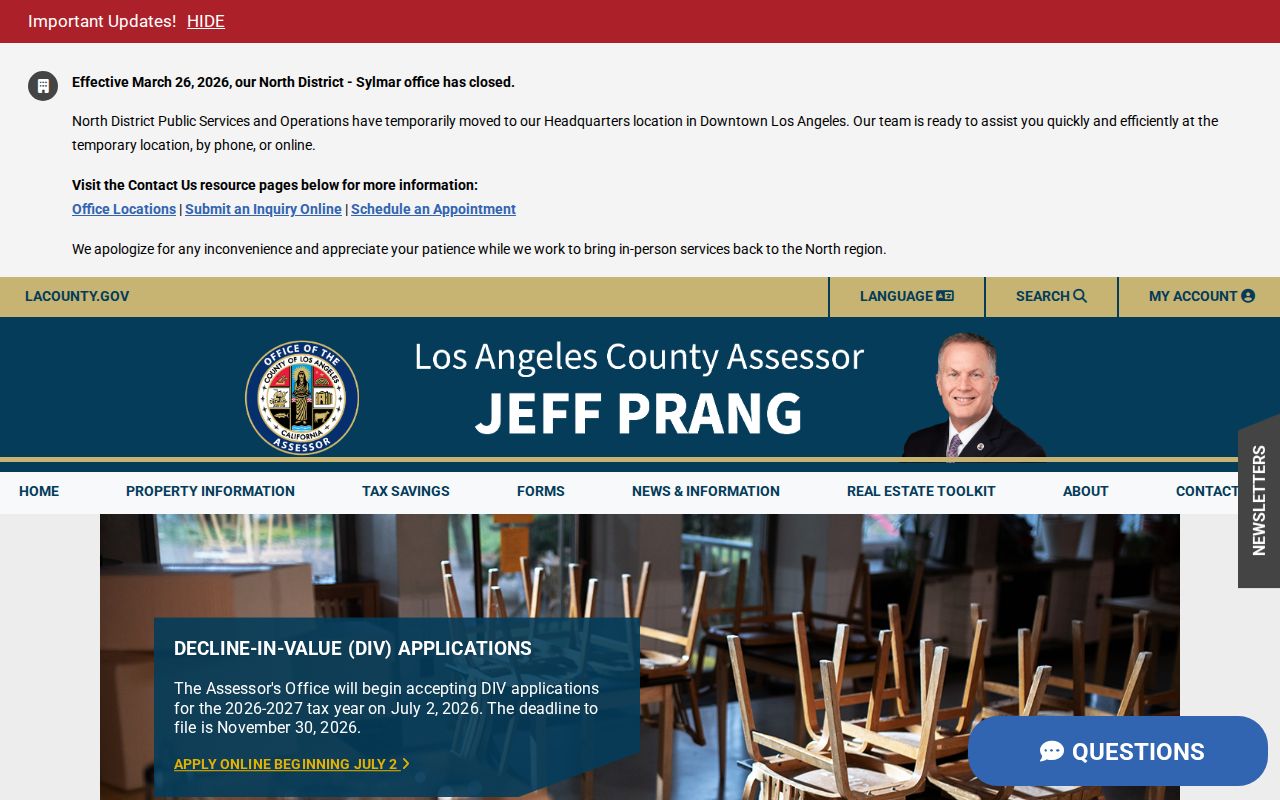
Keep web parcel facts and offline owner data in separate notes. The Assessor public-service numbers are (888) 807-2111 and (213) 974-3211; headquarters is 500 W Temple Street, Room 225, Los Angeles, with published weekday hours of 7:30 to 5:00.
Trace Bellflower Past Owners Through Deeds
Los Angeles County offers no public deed index by street address, AIN, or telephone. The Norwalk index is alphabetical by grantor and grantee with a recording-year search. Start with the owner obtained offline, estimate the acquisition year from parcel events, and search that person as grantee. Read the deed image and legal description, then carry the seller backward as the next grantee search.
- Confirm AIN, situs, parcel changes, and legal description in Assessor and GIS records.
- Obtain the current owner through an Assessor office or Property Data Sales request.
- Search the owner as grantee in the likely year at the Recorder index.
- Record document number, book and page, title, date, grantor, and legal match.
- Search the grantor as an earlier grantee, varying initials, order, trusts, entities, and spelling.
- Repeat backward across both Norwalk record-room periods.
A deed chain shows legal interests, not every person who occupied the house. A trust transfer, inheritance, correction, or intra-family conveyance may look unlike a sale. Match the legal description and document reason at each step instead of treating a surname or street match as proof.
- Grantor / grantee
- The grantor gives or transfers a recorded interest; the grantee receives that interest.
- Chain of title
- The linked sequence of recorded transfers used to follow a parcel from one titleholder to an earlier one.
- Legal description
- The lot, block, subdivision, or other formal property identity that remains more stable than a street label.
- Criss-cross directory
- A reverse directory arranged by street and number, used to find occupants or businesses rather than legal owners.
- Enumeration district
- The census area assigned to an enumerator; its boundaries may not match modern Bellflower city lines.
Bellflower Past Residents at Norwalk
Insider tip: The deed trail crosses a floor boundary at Los Angeles County Registrar-Recorder/County Clerk headquarters, 12400 Imperial Highway, Norwalk. Records from 1851 through 1957 are downstairs on the lower level; 1958 to the present are on the second floor in Real Estate Records Room 2207. Appointments may be made up to two weeks ahead. Desk hours are 8:00 to 5:00 on weekdays except holidays. The recorder line, (800) 201-8999 option 3, and recorder@rrcc.lacounty.gov can explain service, but staff do not perform telephone index searches.
The county's known-document copy request instructions show the ordering route after the document number or book-and-page details are known.
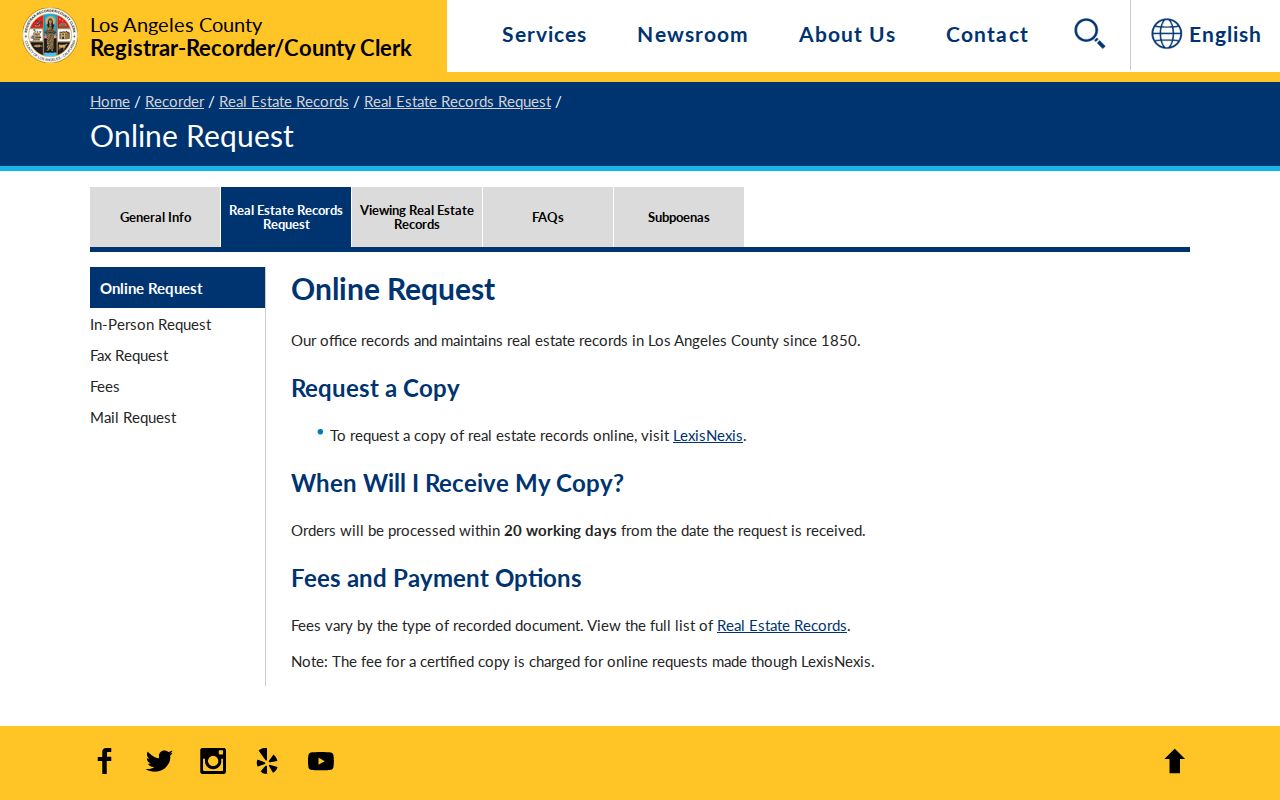
A plain copy costs $5 for the first page and $3 for each added page. A certified copy costs $6 for the first page and $3 for each added page. The county sells the whole document, and online requests state processing within 20 working days. Mail goes to Real Estate Records Section, PO Box 1130, Norwalk, CA 90651-1130. Cards or contactless payment add $1.75; checks and money orders follow the published rules.
An online request is not an online deed search. Web, mail, fax, and vendor channels work only for known documents. Review the free index at Norwalk first. The recording and copy-fee schedule separates a search step from a paid image order. A California Public Records Act request does not replace this specialized service.
Note: The county's online copy route orders a known document; it does not search the grantor-grantee index for an address.
Bellflower Past Households in Directories
Directories supply the occupant layer that deeds leave out. The verified Bellflower-inclusive Polk run is in the FamilySearch catalog: 1940, 1942, 1952, and 1955 volumes of Polk's Lakewood city directory. Login or affiliate limits may affect scans. The Downey Historical Society finding aid lists the 1947 Downey-Bellflower telephone directory in its Reading Room. A telephone listing is narrower than a city directory because an unlisted or telephone-free household can disappear.
Regional material adds more possibilities. The LAPL digitized directory collection includes city, business, telephone, and reverse-street runs, but every issue must be checked for Bellflower coverage. Address OCR often needs an h or r prefix for householder or resident, or a bare and abbreviated street name. Search surnames with maiden, married, hyphenated, and initial variants.
The county's grantor and grantee guidance shows the separate legal-owner trail.
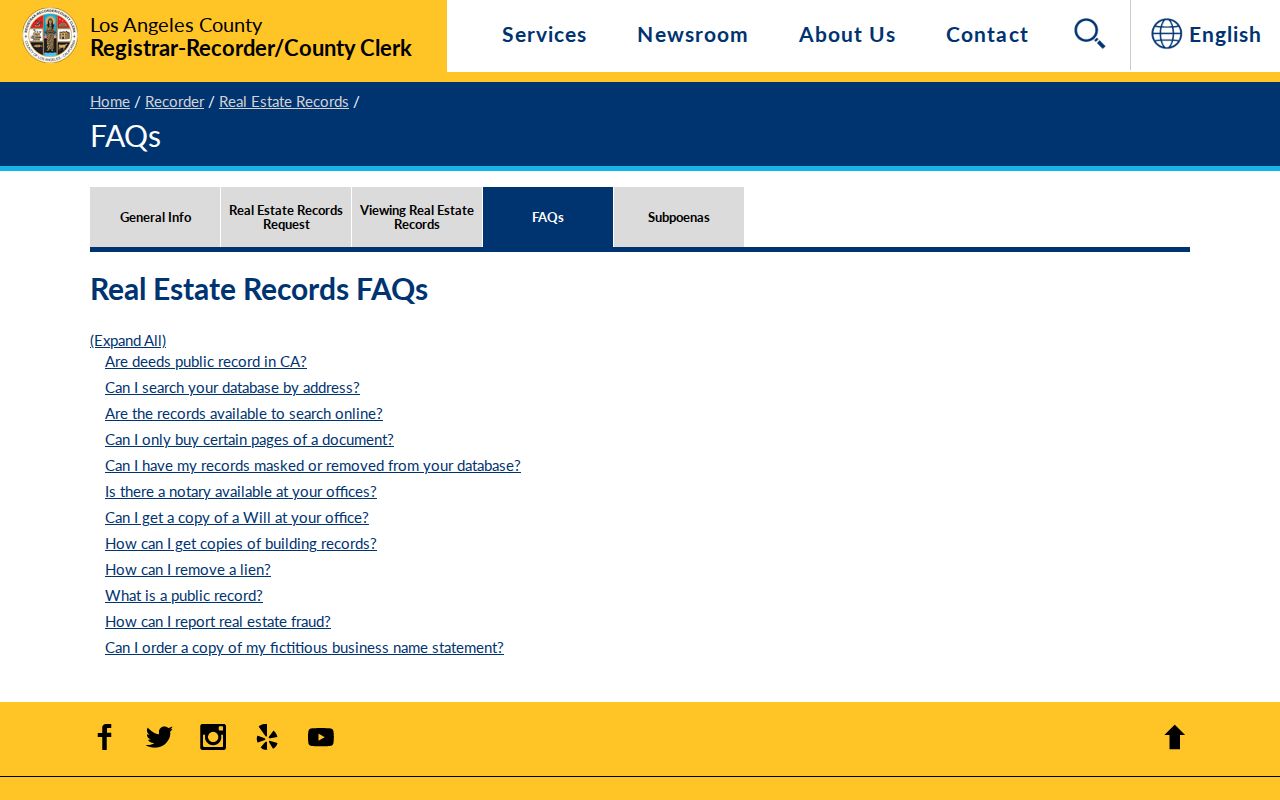
The image reinforces the key distinction: a street address helps locate a directory entry, but it cannot be typed into the county deed index. Keep previous residents, titleholders, and directory occupants in separate evidence columns.
- Pair the 1940 Polk entry with the public 1940 census to compare address, household relationships, ages, and occupation.
- Test 1942 for continuity or a changed address, while treating a missing entry as uncertainty rather than proof of departure.
- Use the 1947 telephone directory as a subscriber check, then note that absence may mean no listing or no telephone.
- Pair the 1950 census with the 1952 and 1955 Polk volumes, comparing spouse, house number, and work details together.
- After 1955, use a reverse issue only when its title expressly includes Bellflower, then bridge gaps with deeds, permits, probate, or obituaries.
The Bellflower city directory reference covers shelf details without confusing historical volumes with the current deed chain.
Bellflower House History: Permits and Maps
Building and code files explain why an address changes or a parcel first appears with a different structure. Bellflower Building and Safety requires permits for patio covers, mechanical, plumbing, electrical, walls, pools, and spas. No verified public permit database was found. Send a focused City Clerk public-record request by address or AIN and date range for permits, inspections, code files, applicant or owner-agent, contractor, scope, valuation, and work dates.
GIS geometry and map history need restraint. Pacific Electric rights-of-way and subdivision records can create easements or unusual lots. San Gabriel and New River flooding, 1914 and 1916 bridge losses, and the 1917 county flood-control district and levees can explain routes or parcel shapes. Sanborn maps show footprint and building use, not every resident. Bellflower appears in the CSUN inventory and LAPL microfilm or Library of Congress scans may help, but exact editions and dates were not verified.
Note: No verified Bellflower renumbering chronology or exact Sanborn edition dates were found, so an old number remains a research question.
Bellflower Past Residents Before Incorporation
Bellflower incorporated on September 3, 1957, after roughly 45 years as an unincorporated community. A search for earlier previous residents should therefore use Los Angeles County, township, precinct, school, post-office, and community labels instead of assuming that every record says Bellflower. Test New River Colony, Somerset, The Willows, The Wilderness, and Bellflower in catalogs and newspaper indexes. The Somerset Optimist began in 1912 and is a useful historical lead, although exact digitized coverage was not verified.
The local school trail is valuable. Somerset School was built in 1910, enlarged in 1914, became Bellflower School and then Washington School, and was demolished in 1951. Before incorporation, the school board was the area's only legally constituted elected body, so its minutes, programs, and yearbooks are quasi-civic records. Student-privacy rules still apply; use published material and approved archival access, not confidential files.
Brakensiek Library offers reference help and countywide databases, making it a practical referral point. Bellflower Historical Society and Carpenter House may hold photographs or leads, but no authoritative online finding aid or public research hours were verified. Ask for historical programs, memorial notices, or anniversary material, not current private rosters.
Bellflower Past Residents at Probate
When a former occupant or titleholder disappears from a directory, probate can close the trail. Wills and probate cases belong to Los Angeles Superior Court, not the Recorder. The county's Find a Case service offers a probate category, while the Archives and Records Center holds many 1910 to 2004 matters on paper, microfilm, or digital media. Public computers in Room 212 locate older files. On-site access allows up to 100 pages the same day, with four requests or 100 pages daily; confidential files require party status and identification.
The Superior Court Archives and Records Center information describes the older-file route.
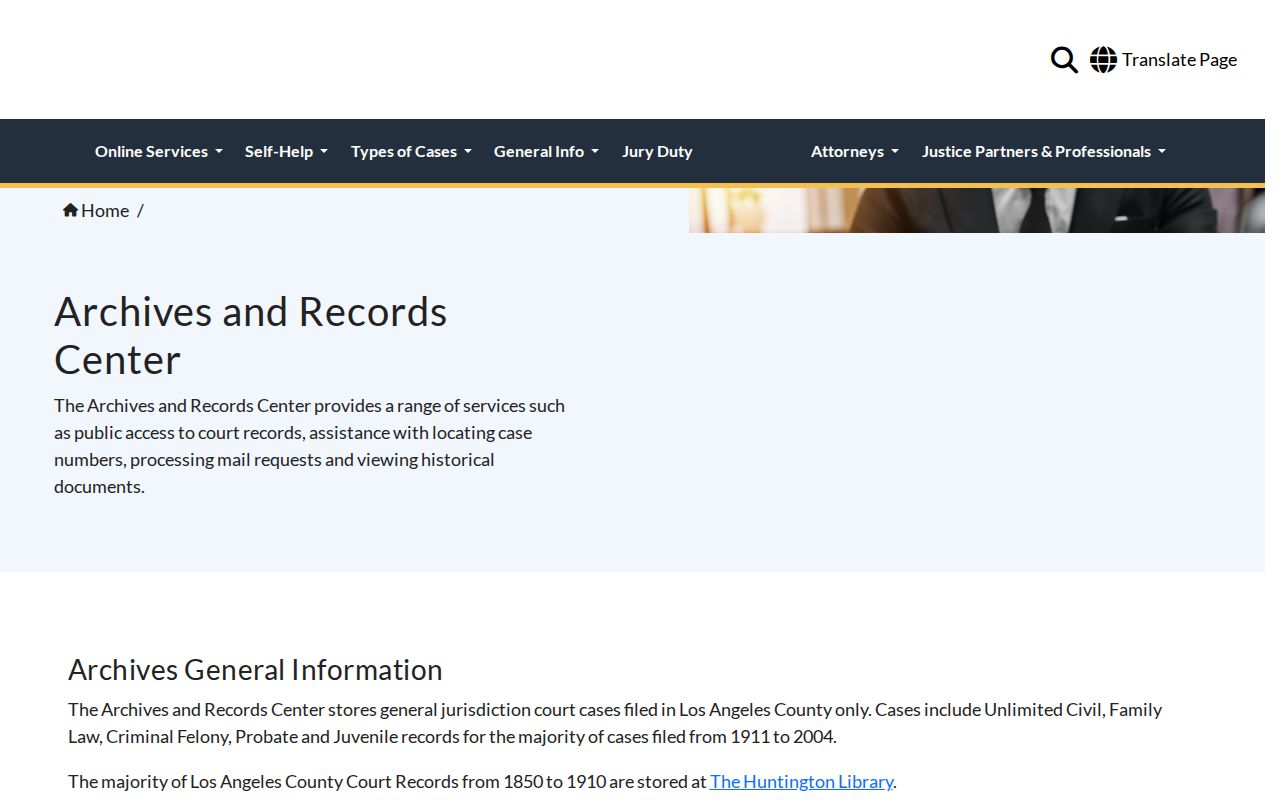
Use the image with a precise case or person lead, then ask the clerk about availability. Mail requests need the case or documents sought, payment, and a self-addressed stamped envelope. Juvenile, sealed, adoption, and other confidential material may not be open. Obituaries, cemetery records, newspaper notices, club memorials, and family-history collections can add context, but no Bellflower-specific obituary or cemetery database was verified.
When one route fails, use Assessor parcel facts and GIS, seek owner data offline, review the Norwalk index, search library directories, ask the Downey Reading Room, request bounded city files, and use court or archive terminals. Label each result as owner, occupant, subscriber, heir, or historical clue.
Lawful house history. Bellflower past residents research is appropriate for family history, genealogy, property history, and personal curiosity. Do not publish a living person's address, use records to track someone, or stalk, harass, threaten, or harm anyone.